
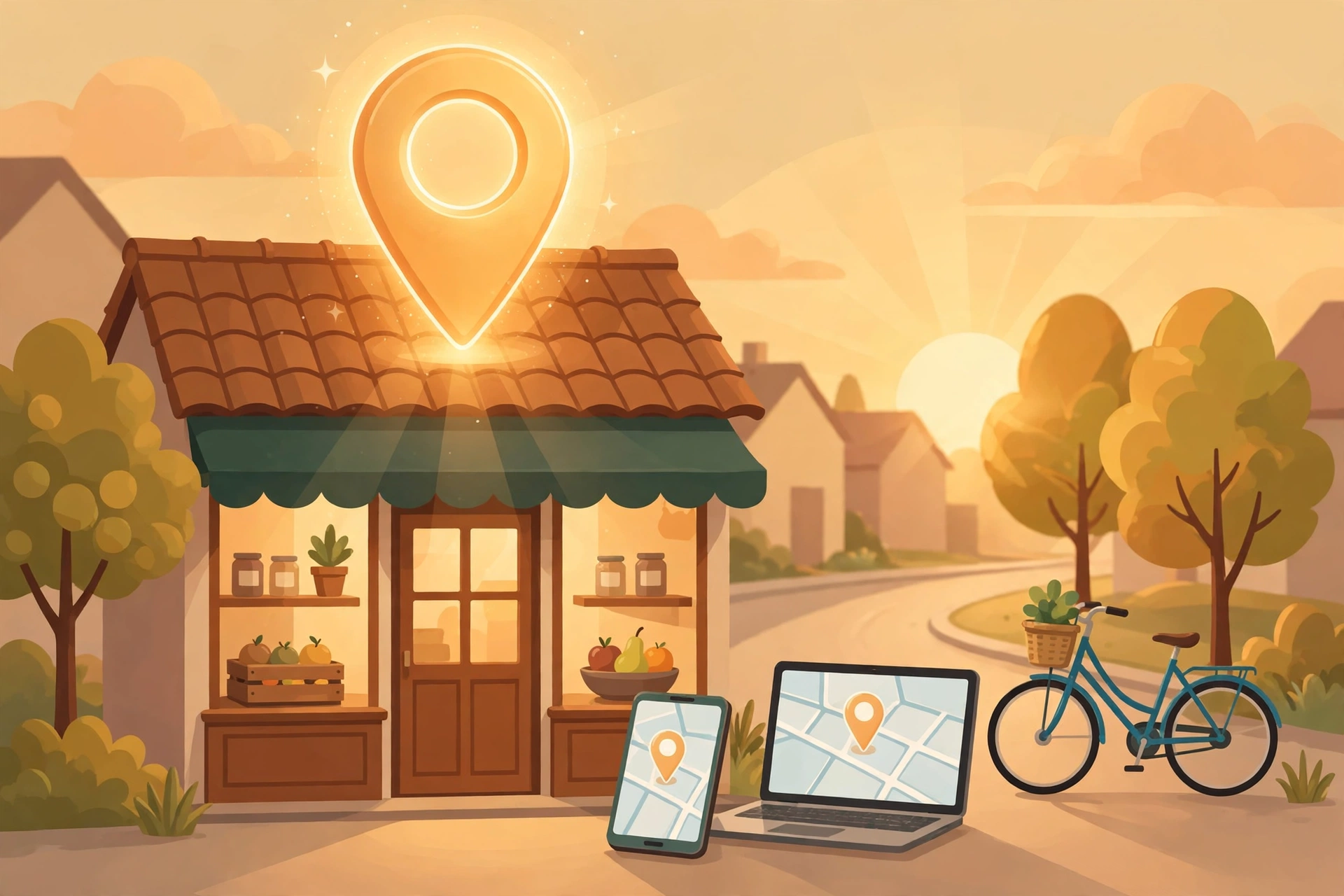
Most small businesses do not need to be found by the whole internet. They need to be found by the people nearby — the ones who can walk through the door, book, or call for a quote today. That is what local SEO is for: making sure your business shows up when someone in your area searches for what you do.
This guide covers the starting point: what local SEO is, how Google chooses which local businesses to show, your Google Business Profile, local keywords, reviews, citations, local content, and measuring what works. No jargon, no inflated promises — just a system a small team can run alongside the business.
Key Takeaways
- Local SEO is about being found by nearby customers at the moment they search — not about ranking nationally for broad terms.
- Your Google Business Profile is the single most important local asset: complete it fully, keep it accurate, and update it regularly.
- Local keywords are service-plus-place phrases your customers actually type, found from real customer language.
- Reviews build trust with customers and with Google: ask for them, answer all of them, and never buy them.
- Keep your business name, address, and phone number identical everywhere they appear online.
- Results build gradually and unevenly. Measure enquiries, calls, and visits, not just rankings.
What Is Local SEO, and Why Does It Matter for Small Businesses?
Local SEO is the work of making your business visible to people searching for what you offer in your area — searches with a place in them, like “plumber in Grantville”, and the map results Google shows alongside them. It matters because those searchers are usually ready to act: they have a problem now, and they want someone close by.
The difference from general SEO is the audience. A national guide can be useful to anyone, anywhere. Local SEO is for the business whose customers come from a town, a suburb, or a handful of postcodes — and for that business, appearing in the local results for its own services matters far more than ranking for a broad term read by people who will never visit. It also suits small businesses because it runs on things they already have: a real address, real customers, and local knowledge no distant competitor can copy.
How Does Google Decide Which Local Businesses to Show?
Google decides which local businesses to show by weighing three things: relevance, distance, and prominence. Relevance is how well your business matches the search. Distance is how close you are to the searcher. Prominence is how well known and trusted your business appears, based on reviews, links, and listings.
You cannot change your distance from a searcher, and you should not try to game it. What you can influence is relevance and prominence. Relevance comes from describing your business clearly: the services you offer, the areas you serve, and the words your customers use for them. Prominence comes from the slow accumulation of good reviews, accurate listings, local mentions, and useful content. Say two plumbers are equally close to a searcher — the one with a complete profile, recent reviews, and a page for each service is easier for Google to match and easier to trust.
What Is a Google Business Profile, and How Do You Set One Up?
A Google Business Profile is the free listing that represents your business on Google Search and Google Maps — the panel with your name, address, hours, phone number, photos, and reviews. For most local searches it is the first thing a customer sees, and often the only thing they need before calling.
Start by claiming or creating the profile and completing every field Google offers. Use your real business name, exactly as it appears on your shopfront and website — do not stuff keywords into the name. Set your address or service area accurately: show the address if customers come to you, or a service area if you travel to them. Add your phone, website, and hours, and keep the hours current. Choose the most accurate primary category, write a short description in plain language, and upload real photos of your premises, your team, and finished jobs. Then treat the profile as a living thing: post updates when something changes, and answer the questions customers ask.
How Do You Choose Local Keywords?
Local keywords are the phrases your nearby customers type when they need what you sell — usually a service plus a place, like “emergency plumber Grantville” or “wedding florist near me”. Choose them the same way you would choose any keywords: from the language your customers actually use, checked against real search behaviour.
Start with your services in plain customer language, then add the places you serve. Your customers will tell you the words: the phrases they use on calls and across the counter are your seed keywords. Our walkthrough of how to do keyword research in 2026 covers that process: seeds, grouping into topics, checking the results page, and mapping one keyword to one page. Two habits matter most: use the place names your customers actually use, and do not create a separate page for every suburb you can name. A page that says nothing new except a swapped place name is thin content; build one strong page per service, and mention the areas you genuinely serve within it.
How Do Reviews Help Your Local SEO?
Reviews help your local SEO in two ways: they tell Google your business is real, active, and trusted, and they tell potential customers the same thing in words they believe more than any advert. A steady flow of recent, genuine reviews is one of the strongest local signals you can build — and it is entirely in your hands.
Ask for reviews as a habit, not as a campaign. The best moment is right after a good experience: a finished job, a happy visit, a problem solved. Ask in person or by email, and make it easy with a direct link to your review page. Our guide to email marketing for small businesses covers that follow-up routine. Answer every review like a person: thank happy customers by name, and for a poor review, reply calmly, acknowledge the issue, and move the detail to a private message or call. Never buy reviews or ask friends or staff to post fake ones — they are easy to spot, they risk your listing, and they destroy real trust.
What Are Citations, and Why Does NAP Consistency Matter?
A citation is any mention of your business name, address, and phone number on another website — a local directory, a review site, a chamber of commerce listing, a supplier page. NAP is shorthand for those three details: name, address, phone. Keeping them identical everywhere matters because Google cross-checks them.
Start with the places that matter most: the major directories and review sites, your local business association, and any suppliers or partners who list you. Use exactly the same name, the same address format, and the same phone number on each one — down to the punctuation. If your shop is “Smith & Sons Plumbing” on your website, do not list it as “Smith and Sons Plumbing” elsewhere. Then audit what is already out there: old addresses, old numbers, and misspelt names all send mixed signals. Fix the important ones first, and work through the rest over time — moving premises is the moment this matters most, so update your website, your profile, and your main listings in the same week.
What Kind of Local Content Should You Publish?
Local content is content that answers the questions your nearby customers ask, in the language they use, with local detail only you could write. It works because it does two jobs at once: it gives search engines pages worth showing for local searches, and it gives customers a reason to choose you over a business that only lists its services.
Start with your service pages, because those earn the enquiries. Each service deserves its own page: what it involves, who it is for, what it costs, and where you offer it. Then add the questions customers ask before they buy: how long a job takes and what to expect. Say you run a small neighbourhood bakery (a hypothetical example), and a page about celebration cakes answers how far ahead to order, what sizes are available, and which suburbs you deliver to. Our content marketing guide for small businesses covers building that kind of content from customer questions. Keep the local detail honest — mentioning a place you do not serve is easy to spot and does nothing for you.
How Do You Earn Local Links Without Buying Them?
Local links are links from other websites in your area — a local newspaper, a community group, a supplier, a nearby business, a local event page. They help because they are the web’s version of a local recommendation: a site rooted in your area vouching for you.
The most reliable route is being part of the local scene. Sponsor a youth team or community event and ask for a link from the event page. Join your local business association and make sure your membership listing links to you. Work with nearby businesses serving the same customers without competing — a florist and a wedding venue, say — and link to each other where it helps a customer. If a local publication writes about your area, offer a quote or a photo. Do not buy links, join link schemes, or pay for placements dressed up as local directories: bought links are against Google’s guidance, and a link from a site with no real connection to your area is worth little.
How Do You Know If Your Local SEO Is Working?
Local SEO is working when it starts conversations you would not have had: calls that mention Google or Maps, enquiries from people in your area who found you by searching, customers arriving who say they looked you up first. Track those business signals first.
Rankings are supporting evidence; a call from a nearby customer is the result that matters. Before you judge anything, use the free measurement that already exists: your Google Business Profile shows how people found your listing, what they did next, and which searches surfaced it. Google Search Console shows the actual queries your website appears for. Then ask new customers how they found you, and write the answer down. Judge over months, not days: a new profile or page may take weeks to be found and longer to settle. Review quarterly — which services bring enquiries, which areas the calls come from — and expect a gradual thickening of local enquiries rather than a sudden flood.
What Mistakes Should Small Businesses Avoid?
The most common mistakes are letting your Google Business Profile go stale, letting your business details drift out of sync across listings, and chasing broad national keywords instead of the service-plus-place phrases your customers actually use. Each of these is easy to fix, and each one quietly costs you enquiries.
The fourth is ignoring reviews, good and bad: unanswered reviews tell readers nobody is listening, and an unanswered complaint speaks louder than the complaint itself. The fifth is creating thin location pages for every suburb on the map, with nothing new on them but a swapped place name. And finally, avoid buying reviews or links: both are easy to spot, both put your listing at risk, and both trade a short-term bump for long-term trust.
What Does a Simple 30-Day Starter Plan Look Like?
A 30-day starter plan gets you from nothing to a working local presence in a month, at a few hours a week. It has four weekly steps: claim and complete your profile, fix your details, ask for reviews, then publish and review.
Week one: claim or create your Google Business Profile and complete every field. Week two: audit your main listings, fix the details wherever they differ, and build your local keyword list from customer language. Week three: ask your three happiest recent customers for a review, answer every review you already have, and improve one service page with local detail. Week four: share the work on social media — our social media marketing guide for small businesses covers how — then check your profile insights and Search Console, ask two recent customers how they found you, and plan next month on what worked.
That is the whole system: one accurate profile, consistent details, a habit of asking for reviews, and one good local page at a time. And if you would rather focus on running the business while someone else runs the system, that is exactly the kind of work covered by our digital marketing services.
Frequently Asked Questions
How long does local SEO take to work?
There is no fixed timeline, and anyone who quotes one is guessing. Expect a gradual build over weeks and months: a profile can start showing quickly, but reviews, citations, and content accumulate slowly. Judge it over quarters, and by enquiries and calls rather than daily ranking checks.
Do I need a website for local SEO?
You can appear on Google Maps with a profile alone, but a website gives your local presence somewhere to stand: your service pages, somewhere customers check you out, and detail your profile cannot hold. A few solid pages — services, areas served, contact details — are enough to start.
Is a Google Business Profile really free?
Yes. Creating and maintaining a Google Business Profile costs nothing. Be wary of anyone charging you to “set it up” as if it were a paid product — the value is in doing it properly and keeping it accurate, not in paying for access to it.
Should I use my home address if I work from home?
Only if you are comfortable with it being public. If you serve customers at their location rather than yours, you can set a service area instead of showing an address. Show the address customers need to find you, and hide it if they never come to you.
Can a small business do local SEO without an agency?
Yes. The core work — an accurate profile, consistent details, genuine reviews, and useful local content — is work a small team can do itself, a few hours a week. An agency is worth considering when you want to move faster, cover more services, or hand the routine over.
Final Thoughts
Local SEO is not about beating national brands or chasing broad keywords. It is about being easy to find, easy to trust, and easy to contact for the people nearby who need what you do. Get the profile right, keep the details consistent, ask for reviews, publish useful local content, and judge it by the conversations it starts.
Do that steadily for a few months, and the map starts working for you the way a good shopfront does: quietly, every day, for customers already looking.